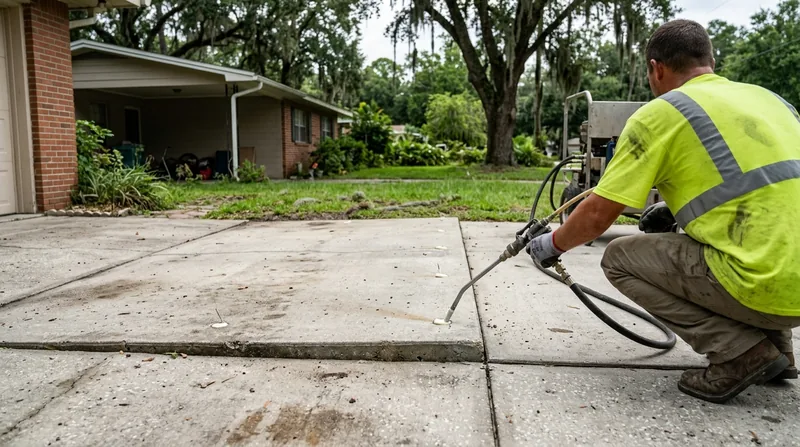




Concrete Leveling & Slab Lifting in Gainesville is the fastest way to fix sunken driveways, patios, and walkways without tearing out and replacing the entire slab. Gainesville's sandy soil over karst limestone, combined with the massive root systems of live oak and laurel oak canopies that shade our historic neighborhoods and newer subdivisions alike, creates ideal conditions for settled concrete. When slabs sink or shift, they create trip hazards, pooling water, and cosmetic damage that only gets worse. We lift and level those slabs back into place using proven methods that cost far less than full replacement and take only a fraction of the time. Whether your driveway in the Duckpond Historic District has settled from decades of oak root pressure, or your patio in Haile Plantation has dropped from shifting fill, we restore it to safe, level condition. Call us at (352) 301-4098 for a free estimate, or learn more about our full range of concrete repair and resurfacing services.
Why Concrete Settling Happens So Fast in Gainesville
Gainesville sits on sandy soil underlain by karst limestone and patches of the clayey Hawthorn Group formation. This geology is unstable by nature. When fill settles, when clay layers compress, or when underground voids collapse, concrete slabs sink unevenly. Our live oak and laurel oak trees, which tower over properties from the oldest Victorian homes on narrow lots to modern two-story brick subdivisions, drive concrete failure even faster. Their surface root systems lift sidewalk panels and driveway edges year after year. Summer thunderstorms and hurricane-season flooding test drainage around slabs, washing away support soil. Unlike regions with freeze-thaw cycles that crack concrete in winter, Gainesville's failure mode is subsidence, root heave, and soil washout.
- Massive live oak and laurel oak root systems lift and crack concrete panels on properties across the Duckpond, Northeast Historic District, and newer neighborhoods.
- Sandy soil over limestone voids allows settlement when fill compacts or underground cavities shift.
- Summer thunderstorms and tropical-storm rainfall wash soil from under slab edges, leaving voids that cause sinking.
- Older concrete on 1950s and 1960s ranch homes often sits on minimal fill and settles more than newer construction.
- Carport slabs and single-car driveways in historic neighborhoods experience uneven settling because of narrow, tree-shaded lots with shallow support.
When concrete settles, it becomes a safety hazard and a water management problem. Leveling it now prevents injury claims and foundation damage later.
Key info: Gainesville's live oak canopy and sandy karst soil are the two biggest drivers of concrete settlement. Homes in the Duckpond, Kirkwood, and Golfview often see sidewalk and driveway panels sink 1 to 3 inches within 10 to 15 years. Leveling stops the damage before it reaches the foundation or creates a trip hazard.
For more on how soil and tree conditions affect concrete, see our page on concrete slabs and foundations.
How Concrete Leveling Works in Gainesville: Our Process
We use two main methods to lift and level sunken concrete: polyurethane foam injection and mudjacking. Both are fast, non-invasive, and cost far less than removing and replacing a slab. We assess your driveway, patio, or walkway on site, identify the cause of settlement (tree roots, soil washout, fill compression), and choose the method that gives you the best long-term result. Most jobs are complete in a single day, and you can use the surface within hours.
- We inspect the settled concrete and use a level to measure the drop across the slab.
- We drill small access holes (typically 1 to 2 inches) at strategic points under the slab.
- We inject polyurethane foam or mudjack slurry through the holes to fill voids and lift the slab back to level.
- We monitor the lift in real time and stop when the slab reaches its original height or the desired grade.
- We seal the access holes and clean the surface.
- You can park or walk on the concrete the same day.
This approach avoids the cost and mess of demolition, haul-away, and new concrete installation. It also preserves the existing surface, which is especially valuable for stamped, colored, or textured finishes.
Local example: A homeowner in Haile Plantation with a 2-car driveway that had settled 2 inches on the north side called us. We drilled four access holes, injected polyurethane foam to lift the slab, and sealed the holes. The job took 4 hours and cost roughly half what a full replacement would have. The driveway has remained level for over two years.
Learn more about concrete driveways and how we maintain them for the long term.
Concrete Leveling Methods: Polyurethane vs. Mudjacking
| Approach | Description | Best for |
|---|---|---|
| Polyurethane Foam Injection | Lightweight, expanding foam is injected under the slab. It fills voids, compacts loose soil, and lifts the concrete with minimal weight or disturbance. Cures in minutes. | Lightweight slabs, areas with poor soil conditions, and jobs where minimal disturbance is critical. Ideal for patios and sidewalks in historic neighborhoods. |
| Mudjacking (Slab Jacking) | A slurry of cement, sand, and water is pumped under the slab. The weight of the slurry and the pressure of injection lift the concrete. Takes 24 to 48 hours to cure fully. | Heavier slabs like driveways, areas with stable soil, and situations where the added weight helps re-compact the base layer. |
| Hybrid (Foam + Mudjack) | Foam is injected first to lift the slab quickly, then mudjack is used to fill remaining voids and add weight for long-term stability. | Complex jobs with multiple failure modes, large driveways, or situations requiring both speed and durability. |
| Leveling with Soil Stabilization | Foam or mudjack is combined with chemical soil stabilization to prevent future settlement caused by tree roots or soil washout. | Gainesville properties with aggressive oak root systems or sandy soil, and cases where the settled slab is near mature trees. |
We recommend the method that best matches your slab, soil, and long-term needs. During your free estimate, we will explain which approach makes sense for your property.
Concrete Leveling & Slab Lifting Cost in Gainesville: What to Expect
Concrete leveling costs in Gainesville typically start at around $4 per square foot, though the final price depends on several factors. A typical sunken driveway or patio section of 300 to 500 square feet might run $1,200 to $2,000 for foam injection, or $1,500 to $2,500 for mudjacking. Larger jobs, complex access, or soil stabilization can push costs higher. The key factors that affect your estimate are the size of the settled area, the cause of the settlement (tree roots, soil washout, or fill compression), the method we recommend, and whether the job requires permits or special access. We always recommend getting two or three estimates from insured contractors so you can compare methods and pricing. For a detailed breakdown of our pricing for this and other services, visit our pricing page.
A settled 400-square-foot driveway in Gainesville will typically cost $1,600 to $2,000 with polyurethane foam injection. If the slab requires mudjacking or soil stabilization, add $300 to $800. If the settled area is difficult to access or the root system of a large oak is the cause, expect the higher end of the range. We charge no travel fee within Gainesville and surrounding areas, so there are no surprise mileage costs.
Call us at (352) 301-4098 for a free, no-obligation estimate. We respond within 24 hours and can often schedule the work within a week.
Concrete Leveling & Slab Lifting Near Me: What Gainesville Homeowners Should Know When Hiring
Choosing the right contractor for concrete leveling is about more than price. You want someone who understands Gainesville's unique soil and tree conditions, carries proper insurance, and can explain the method they will use and why. Before you hire, ask for proof of general liability and workers compensation insurance. Request two or three references from recent jobs in Gainesville or nearby areas, and call them to ask if the work held up and if the contractor cleaned up properly. Understand whether your job requires a permit from Alachua County or the City of Gainesville, especially if the settled concrete is near a right-of-way, a protected tree, or a historic property. If you live in a planned community like Haile Plantation or the Town of Tioga, check your HOA requirements as well. Many HOAs require approval before concrete work begins. Get at least two written estimates so you can compare methods, timelines, and pricing. The cheapest option is not always the best if it uses a method unsuitable for your soil or slab. Contact us with any questions, and we will walk you through the process.
Insurance matters: Always verify that your contractor carries general liability insurance (to cover property damage) and workers compensation insurance (to cover injury to crew members on your property). Ask for a certificate of insurance naming you as an additional insured. Do not hire anyone who cannot provide proof of coverage.
Call (352) 301-4098 or request a free estimate online.
Concrete Leveling & Slab Lifting in Gainesville: Pricing Guide
| Service | Price | Details |
|---|---|---|
| Polyurethane Foam Injection | Starting at $4/sq ft | Lightweight, fast-curing method for patios and sidewalks. Price depends on slab area and number of access holes needed. |
| Mudjacking (Slab Jacking) | Starting at $5/sq ft | Heavier-duty method for driveways. Adds weight to re-compact soil beneath the slab for longer-term stability. |
| Hybrid Foam + Mudjack with Soil Stabilization | Starting at $6/sq ft | Combined method for complex jobs with tree roots or sandy soil. Prevents future settlement under Gainesville's live oak canopy. |
| Large or Complex Jobs | On estimate | Multi-section driveways, patios with multiple settled areas, or jobs requiring special equipment or access need on-site assessment. |
| Travel | Included | No separate mileage or travel charge within Gainesville and surrounding service areas. Cost is built into the estimate. |
| Free Estimate | Free | Call (352) 301-4098 for a no-obligation site visit and written estimate. Response within 24 hours, seven days a week. |
Indicative pricing, the exact cost depends on square footage, finish, and site access. Free personalized estimate within 24h at (352) 301-4098.


